Greenlit right after Mamo, this would mark Hayao Miyazaki's cinematic directorial debut and it fittingly feels like a proto-Ghibli film. The Castle of Cagliostro is a truly great movie – beautifully paced and animated, with a great sense of humor and a warm heart. It gives you enough to understand the characters and their dynamic within moments of meeting them. An exciting adventure in a European castle, with Lupin saving the young Clarisse from the clutches of the wicked Count Cagliostro.
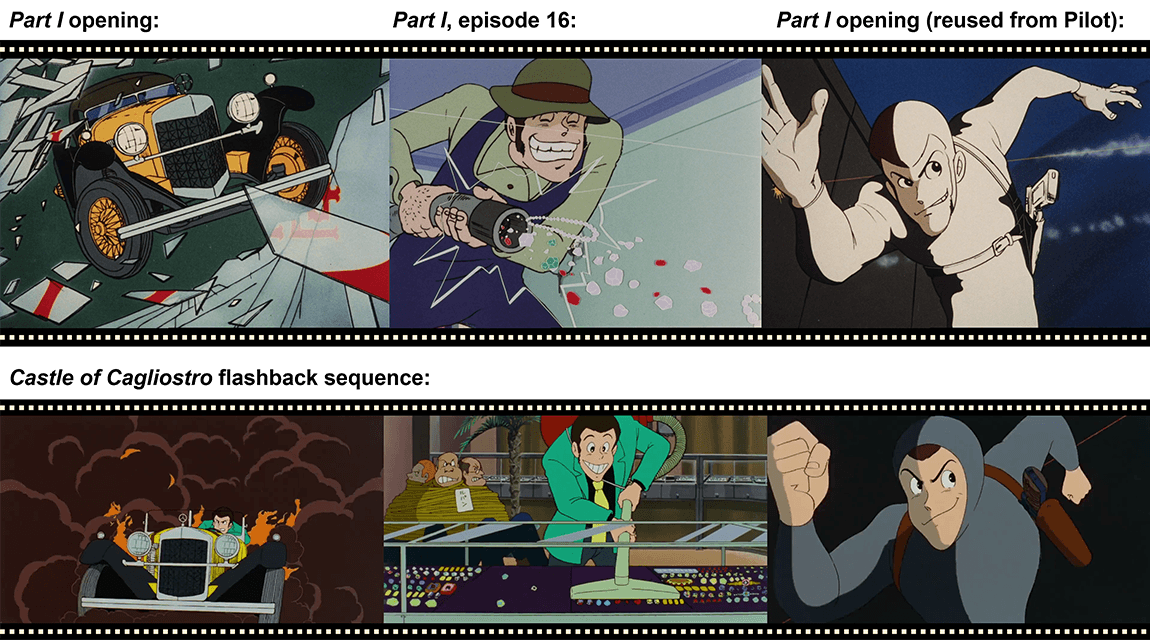
However! What is important to understand is that this is very much not a typical Lupin story – instead, Miyazaki took the opportunity to present a postscript or coda to his work on Part I (indeed, it's not hard to notice similarities with episodes 10 and 21 in particular). This is emphasized in a key sequence where Lupin reflects on his past – and in this flashback he's clearly depicted as a much more aggressive and uninhibited man in a montage that directly references the first anime series:
As Miyazaki explained:
"I felt that Lupin had seen all the glory and ended all its chapters. So I was quite astonished when they were starting up again. I questioned myself: 'What do I want to do with it now? For what kind of audience?' All I could think of was the image of Lupin who lived in his glory in the 60s and early 70s, now living in the regret and shame for his young and wild life. […] He is over the fame and status which came with the money. He is no longer a man who would pull out the most rare and expensive cigarette lighter to light his cigarette anymore[...] he is fine with a cheap disposable one as long as it does the job. I felt like I finally understood Lupin. And based on that image, I created this film.
"Even when it comes to love, he keeps the same stance. Maybe if it was ten years ago, he would have fallen for love, but now he knows he is not that young nor innocent, so he excuses himself as an “old man” and draws the line. (laughs) [...] I hear the fans out there who were looking for a dark, serious and calculative mastermind Lupin were greatly disappointed by this film. That was due to the discrepancy of their image and ours, because I created this Lupin to be nice and even admit he has weaknesses."
Although the mischievous and fun-loving heart of the character is still there, he is a much more serious, calm, and honorable man in this iteration; with his age comes an almost fatherly characterization that's quite different from his "so horny he jumps right out of his clothes and into bed" characterization of Part II et al. Hence the big asterisk on my recommendation – although a fantastic movie it really does not give the impression of the tone to expect going ahead ("maybe the best movie with Lupin in it" but not "the best Lupin movie" if you will). I like to joke that it's like if Logan was your only exposure to the X-Men, you'd surely be surprised at the tone and scale of X2!
Though not the most successful in Japan upon its initial release, it has grown to be quite influential! Not just on Lupin (many movies and specials add a one-off ingénue to the cast, several – notably The First – take more apparent stylish and tonal cues), but anime in general (with Clarisse considered an early example of the moe archetype) and even western animation (with various animated works from Disney, Pixar, WB, and more citing Cagliostro).
As with many older Lupin movies, this one has several dubs with their own quirks:
Featurettes "Miyazaki's Castle" (Reed Nelson) and "Translation Notes" (Shoko Oono, Reed Nelson), Lupin the 3rd: The Castle of Cagliostro Blu-ray Collector's Edition, Discotek Media (2015).
1981, 4 June: Hayao Miyazaki, Yasuo Ohtsuka interview, Lupin the Third.com.
"The Castle of Cagliostro Analysis", A Humble Professor (video no longer publically available)